

STI Testing 101: What Every Sexually Active Woman Should Be Tested For

Here is something that does not get said enough: getting tested for STIs is not something you do because something is wrong. It is something you do because you are paying attention. Because you take your health seriously. Because you understand that many of the most common sexually transmitted infections have no symptoms at all and the only way to know your status is to actually ask for the test.
Yet so many women walk out of annual gynecology appointments having never been tested for a single STI. They had a Pap smear. Maybe a pelvic exam. But nobody asked about their sexual history in a meaningful way, nobody offered a full STI panel, and they assumed that if something was wrong, their doctor would have found it.
That is not how it works. STI testing is not automatic. It is not included in a standard well-woman visit unless you specifically ask or unless your provider takes a thorough sexual history and recommends it. Which means millions of women are walking around with undiagnosed infections that are quietly doing damage, quietly being passed to partners, and quietly affecting long-term reproductive health.
This post is your complete guide to STI testing what tests exist, who needs them, how often, and exactly how to ask for them at your next appointment.
Why STI Testing Is Not Automatic
This surprises a lot of women. You go to the gynecologist. You have a pelvic exam and a Pap smear. Surely they are checking for everything?
They are not.
A Pap smear tests for abnormal cervical cells and sometimes HPV. A pelvic exam checks the physical structures of the reproductive system. Neither of these tests screens for chlamydia, gonorrhea, syphilis, HIV, herpes, trichomoniasis, or hepatitis.
STI testing requires separate swabs, blood draws, or urine samples and in most clinical settings, those tests are only ordered when a patient asks or when a provider actively screens based on risk factors.
This means your job is to know what to ask for.
The STIs Every Sexually Active Woman Should Know About
Chlamydia
Chlamydia is the most commonly reported STI in the United States. It is caused by the bacterium Chlamydia trachomatis and is passed through vaginal, anal, and oral sex.
The most important thing to know about chlamydia is that most women have no symptoms at all. When symptoms do occur they can include unusual discharge, burning with urination, or pelvic pain but the majority of infections are completely silent.
Untreated chlamydia can spread to the uterus and fallopian tubes, causing pelvic inflammatory disease, which can lead to chronic pelvic pain, fallopian tube scarring, and infertility. This damage can happen slowly and silently over months or years.
How it is tested: A vaginal swab or urine sample. It is often tested alongside gonorrhea in a combined NAAT test.
Treatment: Highly curable with antibiotics typically azithromycin or doxycycline.
Who should be screened: The CDC recommends annual chlamydia screening for all sexually active women under 25, and for women 25 and older with new or multiple partners.
Gonorrhea
Gonorrhea is caused by the bacterium Neisseria gonorrhoeae and is passed through vaginal, anal, and oral sex. Like chlamydia, it is often completely asymptomatic in women. When symptoms do occur they may include increased or unusual discharge, burning with urination, or vaginal bleeding between periods.
Untreated gonorrhea carries the same serious risks as chlamydia PID, fallopian tube damage, and infertility. It can also spread to the throat and rectum, where it is even less likely to cause noticeable symptoms.
Gonorrhea has become increasingly antibiotic-resistant in recent years, making early detection and appropriate treatment more important than ever.
How it is tested: A vaginal swab or urine sample, usually alongside chlamydia.
Treatment: Currently treated with injectable ceftriaxone. Due to rising resistance, treatment guidelines are updated regularly.
Who should be screened: Same recommendations as chlamydia annually for sexually active women under 25, and for older women with risk factors.
Trichomoniasis
Trichomoniasis caused by the parasite Trichomonas vaginalis is the most common curable STI in the world, yet it is consistently left off standard STI panels and rarely discussed openly.
Up to 70% of women with trich have no symptoms. When symptoms do appear they can include frothy yellow-green discharge, strong vaginal odor, itching, burning, and pain with urination symptoms that are frequently mistaken for BV or yeast.
Untreated trich increases HIV susceptibility and is associated with pregnancy complications including preterm birth.
How it is tested: A vaginal swab NAAT testing is the most accurate. It must be specifically requested as it is not included in most standard panels.
Treatment: Curable with metronidazole or tinidazole. Both partners must be treated simultaneously.
Who should be screened: Any sexually active woman, particularly those with recurring vaginal symptoms that have not resolved with BV or yeast treatment.
HIV
Human immunodeficiency virus attacks the immune system and if untreated progresses to AIDS. HIV is transmitted through sexual contact, sharing needles, and from mother to child during pregnancy or breastfeeding.
HIV testing is one of the most important and most skipped tests in routine women's healthcare. The CDC recommends that everyone between the ages of 13 and 64 be tested for HIV at least once as part of routine healthcare and more frequently for women with ongoing risk factors.
Modern HIV treatment is highly effective. People living with HIV who are on treatment can have undetectable viral loads, meaning they cannot transmit the virus to partners and can live long, healthy lives. Early detection is everything.
How it is tested: A blood test or oral fluid test. Rapid tests can provide results within minutes.
Who should be screened: Everyone at least once. Women with new or multiple partners, inconsistent condom use, or partners of unknown status should be tested annually or more frequently.
Syphilis
Syphilis is caused by the bacterium Treponema pallidum and progresses through stages if untreated. Primary syphilis causes a painless sore called a chancre at the infection site which is often inside the vagina or cervix and completely invisible. Secondary syphilis may cause a rash, flu-like symptoms, and sores. Without treatment, syphilis progresses to latent and potentially tertiary stages that can cause serious damage to the heart, brain, and other organs.
Syphilis rates in the United States have been rising significantly in recent years, including in women and in cases of congenital syphilis syphilis passed from mother to baby during pregnancy.
How it is tested: A blood test.
Treatment: Curable with penicillin, particularly in early stages.
Who should be screened: Women with new or multiple partners, women who are pregnant, and anyone with symptoms or known exposure
Herpes (HSV-1 and HSV-2)
Herpes simplex virus is extremely common and frequently misunderstood. HSV-1 typically causes oral herpes and HSV-2 typically causes genital herpes though either type can affect either location.
The most important thing to understand about herpes is that most people who have it do not know. The majority of genital herpes infections are asymptomatic or cause symptoms so mild they are never recognized as herpes. Transmission can occur even when no sores are visible through a process called asymptomatic shedding.
Herpes is a manageable condition. It is not curable, but antiviral medications significantly reduce outbreaks and transmission risk. Having herpes does not define your sexual health or your relationships but knowing your status allows you to make informed decisions.
How it is tested: A blood test for HSV antibodies (IgG testing) or a swab of an active sore for the most accurate result. Blood testing has limitations and is best discussed with your provider in context.
Who should be screened: The CDC does not currently recommend routine herpes blood testing for asymptomatic individuals without known exposure, but women with symptoms, known exposure, or who want to know their status for personal reasons can discuss testing with their provider.
HPV and Cervical Cancer Screening
Human papillomavirus is the most common STI virtually everyone who is sexually active will be exposed to HPV at some point. Most HPV infections clear on their own. Some high-risk strains can cause cervical cancer. Some low-risk strains cause genital warts.
There is no HPV test approved to diagnose HPV in the general population outside of cervical cancer screening. HPV screening is integrated into your Pap smear schedule an HPV co-test checks for high-risk HPV strains at the same time as your Pap.
The HPV vaccine (Gardasil 9) is recommended for all people up to age 26 and can be discussed with a provider for adults aged 27 to 45 on a case-by-case basis.
Hepatitis B and Hepatitis C
Both hepatitis B and hepatitis C can be sexually transmitted and can cause serious long-term liver disease if untreated.
Hepatitis B can be prevented by vaccination. Screening is recommended for unvaccinated individuals and those with risk factors.
Hepatitis C the CDC now recommends one-time hepatitis C screening for all adults 18 and older, and periodic screening for those with ongoing risk factors.
Both are tested via blood draw and both are treatable hepatitis C is now curable with modern antiviral medications.
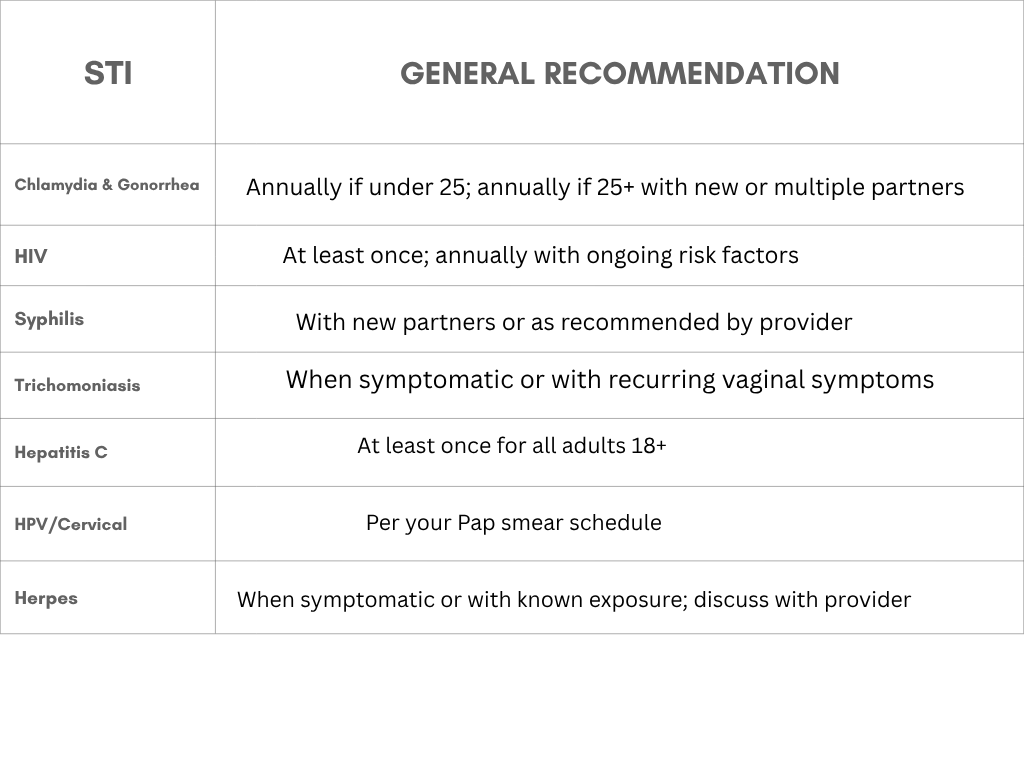
How Often Should You Be Tested?
Here is a simple framework:
How to Ask for STI Testing at Your Appointment
Many women find it uncomfortable to bring up STI testing. Here is exactly what you can say:
"I would like a full STI panel today including chlamydia, gonorrhea, trichomoniasis, HIV, syphilis, and hepatitis C."
You do not need to justify that request. You do not need to explain your sexual history in detail unless you want to. Asking for STI testing is the same as asking for any other health screening. It is a responsible, normal part of taking care of yourself.
If your provider seems dismissive or skips over your request, you can follow up with:
"I want to make sure trichomoniasis is included specifically I know it is sometimes left off standard panels."
When was the last time you had a full STI panel not just a Pap, but the whole picture? Drop a comment below. Knowing your status is one of the most powerful things you can do for your health.
“This article is based on current medical guidance and research from the following trusted sources:”
Resources & Sources
Centers for Disease Control and Prevention (CDC) STI Testing Recommendations -
cdc.gov/std
American College of Obstetricians and Gynecologists (ACOG) Sexually Transmitted Infections -
acog.org
Office on Women's Health Sexually Transmitted Infections -
womenshealth.gov
Planned Parenthood STD Testing: What You Need to Know -
plannedparenthood.org
National Institutes of Health (NIH) / PubMed STI prevalence and screening research -
pubmed.ncbi.nlm.nih.gov
Cleveland Clinic Sexually Transmitted Infections: Testing and Prevention -
clevelandclinic.org
Becky Freeman is the founder of BVTalks® and Bee Vee Clean. She focuses on women’s intimate health, vaginal microbiome education, and creating practical, easy-to-understand content for everyday care.
Disclaimer: This post is for educational purposes only and is not a substitute for professional medical advice. Always consult your healthcare provider for diagnosis and treatment.
