

Hormone Therapy in 2026: Updated Risks, Benefits, and Who Should Actually Consider It

For more than two decades, hormone therapy carried a reputation built largely on fear. A single study the Women's Health Initiative (WHI), published in 2002 reshaped how an entire generation of women and their doctors thought about estrogen. Prescriptions plummeted. Women were told to avoid it. Suffering through hot flashes, sleeplessness, bone loss, and vaginal atrophy became, for many providers, the medically responsible recommendation.
That era is over.
In November 2025, the FDA removed the decades-old boxed warnings from estrogen-containing hormone therapies the most significant regulatory update to menopausal hormone therapy in over 20 years. This change reflects a fundamental reassessment of the evidence: the original WHI conclusions have been substantially reinterpreted, newer and better studies have accumulated, and major medical organizations have been saying for years that for the right woman, at the right time, hormone therapy is not only safe it is often the most effective treatment available.
This post explains what changed, what the current evidence actually shows, who benefits most, what the real risks look like in 2026, and how to have a productive conversation with your provider.
What the WHI Actually Got Wrong and Why It Mattered So Much
The Women's Health Initiative was a large, well-intentioned study that produced findings that were widely misapplied. Understanding why matters, because the misapplication caused enormous harm.
The WHI enrolled women with an average age of 63 a full decade past the average age of menopause. Many participants were obese, had pre-existing cardiovascular risk factors, and were starting hormone therapy long after menopause had begun. The primary hormone therapy used was oral conjugated equine estrogen combined with medroxyprogesterone acetate (a synthetic progestin) formulations that are now understood to carry different risk profiles than the bioidentical and transdermal options available today.
When the WHI reported increased risks of breast cancer, heart disease, and stroke in this population, the findings were applied universally to all women, at all ages, with all formulations. This was a categorical error. A 63-year-old woman with cardiovascular risk factors starting oral synthetic hormone therapy is not the same clinical picture as a 50-year-old in early menopause starting transdermal estradiol with micronized progesterone.
The reanalysis of WHI data published in subsequent years, and the accumulation of newer evidence, has consistently shown that the timing of initiation is critical. Women who begin hormone therapy within ten years of menopause onset or before age 60 the so-called "timing hypothesis" or "window of opportunity" have a fundamentally different risk-benefit profile than women who begin it at 63.
The FDA's 2025 Regulatory Update: What Actually Changed
In November 2025, the FDA updated the labeling for estrogen-containing hormone therapies, removing the black box warnings that had been in place since 2003. This was not a minor administrative change black box warnings are the FDA's strongest safety signal, and their presence on a drug fundamentally shapes how physicians prescribe it and how patients perceive it.
The update reflected the FDA's expert panel review from July 2025, which concluded that the existing warnings were not accurately representing the current evidence base. Specifically:
The cardiovascular and breast cancer risk language was updated to reflect that these risks are not uniform across all ages, all formulations, and all timing of initiation
The warnings now better distinguish between oral and transdermal routes, and between synthetic progestins and micronized progesterone
The updated labeling aligns more closely with the positions of The Menopause Society and major international bodies
This does not mean hormone therapy is risk-free. It means the risk communication is now more accurate and that the decades of overcorrection driven by poorly contextualized WHI data have officially been acknowledged at the regulatory level.
What the 2025–2026 Guidelines Actually Say
The Menopause Society (formerly NAMS), the British Menopause Society, and the International Menopause Society have all updated their position statements in 2025 and early 2026. The core conclusions are consistent:
For women under 60 or within 10 years of menopause onset who have no contraindications:
The benefits of hormone therapy outweigh the risks when used to treat vasomotor symptoms (hot flashes, night sweats), genitourinary syndrome of menopause (vaginal dryness, painful sex, recurrent UTIs), sleep disruption, and mood changes. Hormone therapy also provides meaningful protection against osteoporosis and may reduce cardiovascular risk when initiated in the window of opportunity.
For women over 60 or more than 10 years post-menopause:
The risk-benefit calculation is less favorable, particularly for cardiovascular disease. Initiating hormone therapy in this population requires more careful individualized assessment.
The formulation matters:
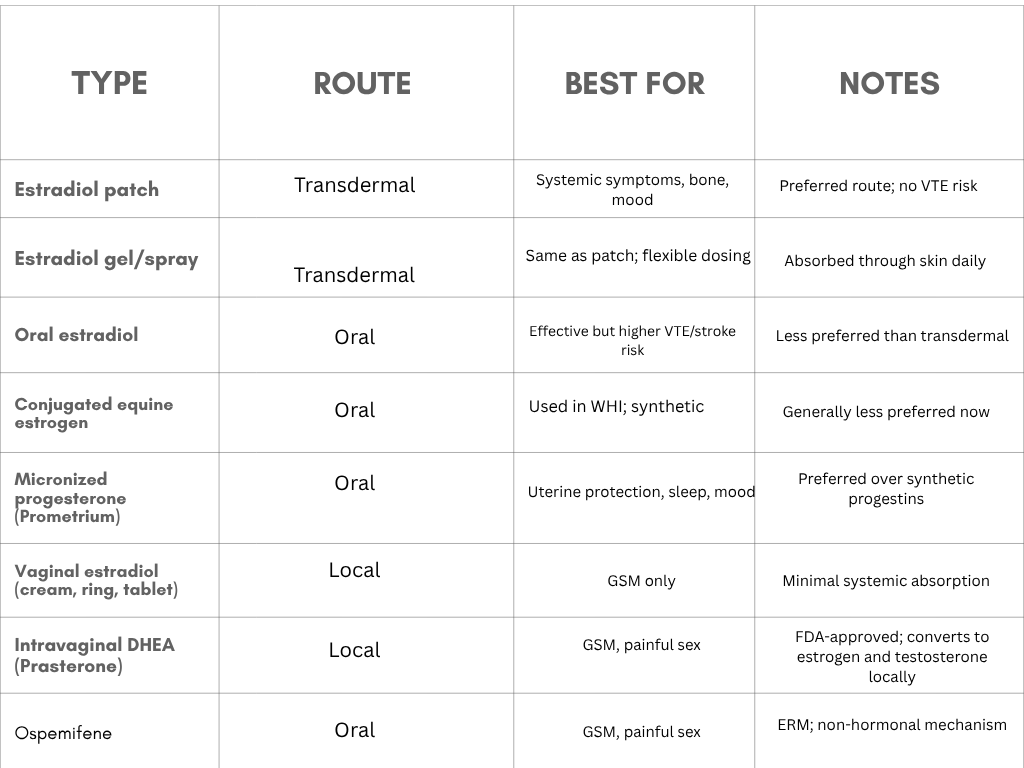
Transdermal estradiol does not carry the same blood clot and stroke risk as oral estrogen because it bypasses first-pass liver metabolism. Micronized progesterone (bioidentical) does not carry the same breast cancer signal as synthetic progestins (medroxyprogesterone acetate). These distinctions are clinically meaningful and should drive prescribing decisions.
The Real Benefits of Hormone Therapy
For appropriate candidates, hormone therapy addresses a wide spectrum of menopausal symptoms and long-term health risks:
Vasomotor symptoms: Hot flashes and night sweats are the most common reason women seek menopausal treatment, affecting up to 80% of women during the menopause transition. Hormone therapy is the most effective treatment available reducing frequency and severity significantly more than any non-hormonal alternative.
Sleep: Night sweats and estrogen withdrawal both disrupt sleep architecture. Hormone therapy improves sleep quality by addressing both the night sweat trigger and the direct neurological effects of estrogen on sleep regulation.
Genitourinary syndrome of menopause (GSM): Vaginal atrophy, dryness, painful sex, urinary urgency, and recurrent UTIs are caused by estrogen deficiency in the genitourinary tissue. Low-dose vaginal estrogen which has minimal systemic absorption is highly effective for GSM and is considered safe even for women who cannot use systemic hormone therapy.
Bone health: Estrogen is essential for bone density maintenance. Women lose bone mass rapidly in the first years after menopause. Hormone therapy prevents this loss and reduces fracture risk with effects that last as long as therapy continues.
Cardiovascular protection (in the window of opportunity): When initiated before age 60 or within 10 years of menopause, estrogen therapy is associated with reduced cardiovascular risk in women without pre-existing heart disease. This is the opposite of what many women were told after 2002.
Mood and cognitive function: Estrogen has direct effects on serotonin and dopamine pathways. Many women experience significant mood improvement and clearer cognitive function with hormone therapy particularly when mood changes are directly tied to the menopause transition rather than independent depression.
Quality of life: Across all measures, women who use hormone therapy for symptomatic menopause report substantially higher quality of life than those who do not. This is not a trivial outcome years of disrupted sleep, painful sex, cognitive fog, and emotional instability have real costs.
The Real Risks: What the Evidence Actually Shows in 2026
Hormone therapy is not without risk. An honest conversation requires naming them clearly.
Breast cancer:
This is the risk that drives the most fear, and it deserves a nuanced answer. Combined estrogen-progestogen therapy (particularly with synthetic progestins) is associated with a small increased risk of breast cancer with prolonged use estimated in the WHI at approximately 8 additional cases per 10,000 women per year. This is a real signal, and it is why the type of progestogen matters: micronized progesterone has a significantly more favorable breast cancer profile than synthetic progestins in multiple observational studies. Estrogen-only therapy (appropriate for women who have had a hysterectomy) is not associated with increased breast cancer risk and may be slightly protective.
Blood clots (VTE):
Oral estrogen increases the risk of venous thromboembolism (blood clots). Transdermal estradiol does not carry this risk it bypasses first-pass liver metabolism and does not affect clotting factor production. For women with elevated clot risk, transdermal is strongly preferred.
Stroke:
Oral estrogen is associated with a small increased stroke risk. Transdermal estrogen is not, or the risk is significantly lower. Again, route of administration matters.
Who should not use systemic hormone therapy:
Women with a personal history of estrogen-receptor positive breast cancer
Women with a history of blood clots or known clotting disorders
Women with active cardiovascular disease
Women with undiagnosed abnormal vaginal bleeding
Women with active liver disease
Low-dose vaginal estrogen for GSM alone has a different and much more favorable safety profile than systemic hormone therapy and is appropriate for many women who cannot use systemic therapy.
The Formulations: What Is Available in 2026
Who Should Consider Hormone Therapy
Strong candidates:
Women under 60 or within 10 years of menopause with moderate to severe hot flashes, night sweats, or sleep disruption
Women with significant genitourinary syndrome of menopause (vaginal dryness, painful sex, recurrent UTIs)
Women with early menopause (before age 45) or premature ovarian insufficiency (before age 40) for whom hormone therapy until at least age 51 is strongly recommended to protect bone and cardiovascular health
Women with significant mood changes, cognitive symptoms, or quality-of-life impairment directly tied to the menopause transition
Women who need individualized discussion:
Women with a family history of breast cancer not automatically excluded; requires careful risk-benefit assessment
Women over 60 considering hormone therapy for the first time
Women with treated cardiovascular conditions
Women for whom systemic HRT is contraindicated but vaginal estrogen may still be appropriate:
Women with a history of hormone-receptor positive breast cancer discuss with oncologist; low-dose vaginal estrogen may be considered in cases of severe GSM symptoms
Questions to Ask Your Provider
Am I a candidate for hormone therapy given my age, symptoms, and health history?
Which formulation and route do you recommend for me, and why?
Do you recommend transdermal estradiol rather than oral? If not, why?
If I still have a uterus, which progestogen do you recommend micronized progesterone or a synthetic progestin?
How long can I safely remain on hormone therapy?
How will we monitor and reassess my treatment over time?
If I cannot use systemic hormone therapy, what are my options for GSM symptoms?
The Bottom Line
The conversation about hormone therapy changed in 2025 officially, at the regulatory level, and in ways that reflect what the evidence has been showing for over a decade. For women in the window of opportunity under 60, within 10 years of menopause, without contraindications the benefits of hormone therapy for quality of life, bone health, cardiovascular protection, and relief from debilitating symptoms are real and substantial.
The decision is individual. It requires an honest conversation with a provider who is current on the evidence, knows your health history, and is willing to discuss formulations rather than defaulting to the most conservative position out of outdated caution.
You deserve that conversation. And you deserve accurate information to walk into it.
“This article is based on current medical guidance and research from the following trusted sources:”
Resources & Sources
FDA Expert Panel on Menopausal Hormone Therapy — July 2025 Review: pubmed.ncbi.nlm.nih.gov
PMC / NIH — The 2025 Menopausal Hormone Therapy Guidelines: pmc.ncbi.nlm.nih.gov
PMC / NIH — Introduction to Clinical Practice Guidelines for Menopause 2026: pmc.ncbi.nlm.nih.gov
PubMed — Menopausal Hormone Therapy: Making Sense of Current Evidence (2025): pubmed.ncbi.nlm.nih.gov
FindMyHRT — What the 2025–2026 Menopause Society Guidelines Mean for You: findmyhrt.com
FDA Update — Hormone Therapy for Menopause (FORCE/XRAY): facingourrisk.org
The Menopause Society — Position Statement on Hormone Therapy: menopause.org
Breast Cancer Research News — NAMS Updates HRT Position Statement: breastcancer.org
Mayo Clinic — Hormone Therapy: Is It Right for You? mayoclinic.org
Cleveland Clinic — Hormone Replacement Therapy (HRT): clevelandclinic.org
Were you told to avoid hormone therapy or did you have to fight for it? Your experience matters and it might be exactly what the woman reading this at 2 a.m. needs to hear. Leave a comment below.
Author
Becky Freeman is the founder of BVTalks® and Bee Vee Clean. She focuses on women’s intimate health, vaginal microbiome education, and creating practical, easy-to-understand content for everyday care.
Disclaimer: This post is for educational purposes only and is not a substitute for professional medical advice. Always consult your healthcare provider for personalized guidance.
