

Pelvic Organ Prolapse: Heaviness, Bulging, and “Something Coming Down” After Birth and in Midlife
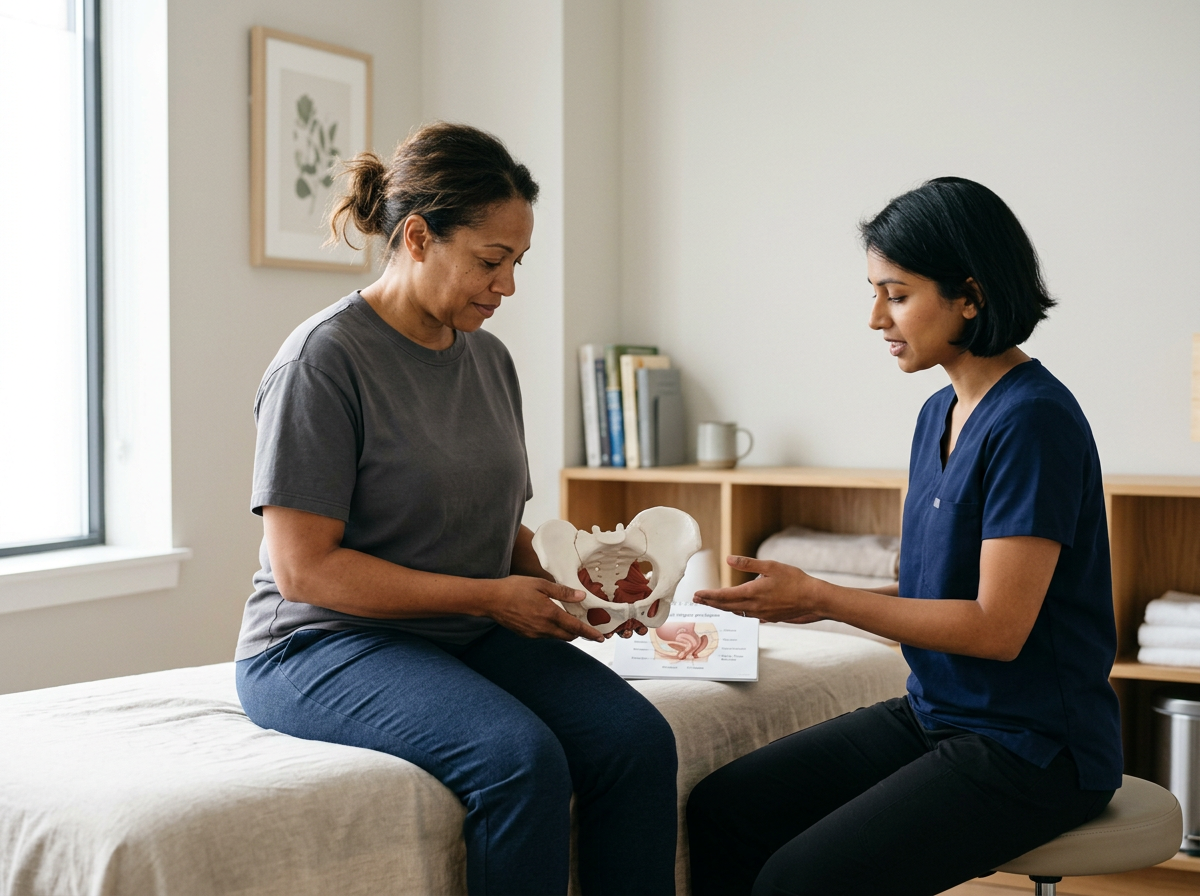
A few months or years after childbirth, you notice:
A heavy, dragging feeling in your pelvis by the end of the day.
A sense of “something coming down” in your vagina, especially when you’re on your feet.
Peeing more often, or leaking when you laugh, lift, or run.
Sex feeling different less sensation, more discomfort, or a feeling of pressure.
You assume you’re alone. Or that this is just the price of becoming a mom or getting older.
In reality, pelvic organ prolapse (POP) when the bladder, uterus, or rectum descend and bulge into the vagina because the pelvic floor support is weakened is extremely common after vaginal birth and in later life. It’s not life‑threatening, but it can quietly wreck comfort, confidence, sex, and mental health if no one explains what’s going on
This post walks through:
What prolapse actually is (and isn’t)
How common it is postpartum and in midlife
Typical symptoms that women are scared to say out loud
Risk factors (birth, age, BMI, lifestyle)
What treatment options exist beyond “do Kegels or have surgery”
What Pelvic Organ Prolapse Actually Is
Your pelvic organs (bladder, uterus, bowel) are supported by muscles and connective tissue the levator ani muscles, ligaments, and fascia that make up the pelvic floor
When these supports are overstretched, torn, or weakened, the organs can bulge down into the vagina, leading to different types of prolapse:
Anterior prolapse (cystocele): bladder bulges into the front vaginal wall.
Posterior prolapse (rectocele): rectum bulges into the back vaginal wall.
Apical prolapse: uterus or vaginal vault descends downward.
Pelvic organ prolapse is graded by how far tissue descends, but even mild prolapse can cause significant symptoms especially heaviness and dragging
You can have anatomical prolapse without symptoms (seen on exam or imaging only), and symptomatic prolapse where you actually feel a bulge or heaviness
How Common Prolapse Is: Postpartum and Later Life
Postpartum
Studies in postpartum women show prolapse is the rule, not the exception:
A large cross‑sectional study of 8,565 postpartum women found 72.8% had some degree of prolapse, mostly stage I (mild)
MRI‑based studies of primiparous women (first vaginal birth) found 12–41% had POP at 6 weeks postpartum, often cystoceles with uterine descent, even if they had no obvious symptoms
Prospective postpartum research reports 8–16% with stage II prolapse and 16–23% with vaginal wall prolapse at 6 weeks
Longitudinal data suggest detectable POP shortly after delivery in about one‑third of births, with up to 46% developing POP after delivery and many not being identified in time
Symptomatic prolapse (where women feel heaviness/bulge) is also common:
A Japanese cohort found 43% of postpartum women reported prolapse symptoms in the first 6 months, and ~36% had symptoms at some point in the first 5 years after childbirth
The Pelvic Studio notes that approximately 1 in 2 women who have had a vaginal birth will experience some degree of prolapse
Many women never mention these symptoms unless directly asked
Later life
In older age, symptomatic POP is also frequent:
A national US study found 23.7% of adult women had at least one pelvic floor disorder (incontinence, prolapse, or fecal incontinence)
RCOG patient information states POP is common, affecting around 1 in 10 women over 50, though many have mild prolapse without symptoms
The lifetime risk of surgery for POP or incontinence by age 80 is estimated to be about 11–20% (roughly 1 in 5 women undergo pelvic floor surgery).
So if you feel like your body is “falling apart” after birth or in your 40s–50s, that’s not failure it’s a known, widespread condition.
Typical Symptoms: Heaviness, Bulge, Bladder, Bowel, and Sex Changes
Your symptoms depend on the type and degree of prolapse
Common experiences include:pmc.ncbi.nlm.nih+2
Heaviness or dragging in the pelvis
Often worse by the end of the day or after prolonged standing.
May improve when you lie down
Feeling or seeing a bulge
A fullness inside the vagina or something “coming down.”
Bladder symptoms
Frequency and urgency.
Difficulty starting urine or feeling you haven’t fully emptied.
Stress leakage (when coughing, laughing, lifting)
Bowel symptoms
Constipation or difficulty emptying.
Need to press on the vaginal bulge or perineum to help stool come out
Sexual changes
Sex feeling different, uncomfortable, or less pleasurable.
Anxiety about sex because of a bulge, heaviness, or fear of worsening prolapse
Some women have no symptoms despite prolapse on exam or imaging; others have significant symptoms with only mild anatomic descent
Risk Factors: Birth, Age, BMI, Lifestyle
Key contributors include:
Vaginal birth (especially first birth)
Vaginal delivery is strongly associated with prolapse later, with odds ratios around 5.6–9.7 for prolapse to or beyond the hymen compared with nulliparous women
Large postpartum studies show vaginal delivery is a major risk factor for anterior and posterior POP and postpartum incontinence
Instrumental birth (forceps, vacuum)
Instrumental vaginal deliveries are associated with higher prolapse symptom rates than spontaneous vaginal births
Risk rises with more births, though the biggest jump may be with the first vaginal birth
Age and menopause
Prolapse risk increases with age; prevalence of pelvic floor disorders more than doubles in women 80+
High BMI and heavy lifting
Higher pre‑pregnancy BMI and ongoing heavy lifting increase strain on pelvic supports
Levator ani muscle injury
Vaginal birth can injure or overstretch the levator ani muscle, contributing to prolapse
Cesarean section reduces but does not eliminate pelvic floor disorder risk; even women with cesareans during labor can develop prolapse
Is Prolapse Dangerous?
Prolapse is not life‑threatening, but can seriously affect quality of life:
Chronic discomfort and pain.
Activity limitation (standing, exercise, lifting).
Sleep disruption from bladder symptoms.
Impact on body image, sexuality, and mood (frustration, anxiety, sadness)
Left unmanaged, prolapse can worsen over time, especially with ongoing strain, constipation, heavy lifting, or untreated pelvic floor weakness
What Can Actually Help: Management Options
Treatment depends on symptom severity, type of prolapse, age, and goals (e.g., future pregnancies, desire to avoid surgery)
Lifestyle Changes and Symptom‑Friendly Habits
RCOG and other guidelines recommend:
Weight management if overweight reducing pelvic load.
Treating chronic cough and stopping smoking.
Preventing constipation (fiber, fluids, gentle laxatives when needed).
Avoiding heavy lifting and high‑impact activities (e.g., heavy weightlifting, trampolining) that strain the pelvic floor.
These won’t reverse prolapse but can limit progression and ease discomfort
Pelvic Floor Muscle Training (PFMT)
Pelvic floor physiotherapy is a first‑line intervention, especially for mild prolapse and postpartum women:
Focuses on correct muscle activation, not just generic “Kegels.”
Can improve support, reduce symptoms, and help urinary leakage.
Should be guided by a pelvic health physical therapist, who can tailor exercise, address overactivity or weakness, and integrate breath and posture.
Studies and reviews highlight pelvic floor rehab as a first‑line treatment for many postpartum POP cases
Pessaries
A pessary is a silicone device inserted into the vagina to support prolapsed organs
Can be used for:
Symptom relief in women who aren’t ready for surgery.
Pregnant or postpartum women.
Women with medical conditions that make surgery risky.
Many women can use pessaries long‑term with regular checks and cleaning
Surgery
Surgery is considered when:
Prolapse is moderate‑to‑severe and significantly affects quality of life.
Conservative measures (PFMT, pessary, lifestyle changes) are inadequate.
The woman has completed childbearing or understands surgical implications for future pregnancy.
Options include:
Reconstructive surgery to restore pelvic support (e.g., anterior/posterior repairs, sacrocolpopexy, uterine suspension).
Obliterative surgery (e.g., colpocleisis) for women who no longer desire vaginal intercourse
The lifetime risk of POP surgery by age 80 is roughly 11–20%. Decisions are individualized and should include a discussion of benefits, risks, recurrence, and impact on sexual function.
How to Talk to Your Doctor When You Feel “Something Coming Down”
You’re allowed to say, “My pelvic floor feels different, and I want you to take that seriously.”
You might use language like:
“Since having my baby / in the last few years, I’ve felt heaviness and a dragging sensation in my pelvis, sometimes a bulge in my vagina, and changes in bladder or bowel habits. I’m worried this could be pelvic organ prolapse. Can we do a focused pelvic exam, talk about pelvic floor rehab, pessaries, and when surgery is actually needed rather than just telling me this is normal after birth or with age?”
Ask about:
A proper speculum and pelvic floor exam using POP‑Q or similar staging.
Referral to pelvic health physiotherapy.
Whether a pessary might help your symptoms.
When and whether surgical consultation makes sense for you.
Your sense of heaviness and “something coming down” is not you being dramatic it’s often a sign of a very common, very real condition that deserves more than silence and resignation.
“This article is based on current medical guidance and research from the following trusted sources:”
Resources & Sources
Postpartum Pelvic Organ Prolapse – Large Cross‑Sectional Study.
https://www.frontiersin.org/journals/medicine/articles/10.3389/fmed.2025.1663043/fullfrontiersinPostpartum Pelvic Floor Disorders – Evaluation and Management.
https://pmc.ncbi.nlm.nih.gov/articles/PMC12226706/pmc.ncbi.nlm.nihPelvic Floor Dysfunction and Electrophysiology in Postpartum Women.
https://www.frontiersin.org/journals/physiology/articles/10.3389/fphys.2023.1165583/fullfrontiersinPelvic Floor Disorders 3–5 Years After First Delivery.
https://pubmed.ncbi.nlm.nih.gov/28197646/pubmed.ncbi.nlm.nihPostnatal Prolapse – The Pelvic Studio.
https://www.thepelvicstudio.com/blog/postnatalprolapsethepelvicstudioPelvic Floor Support Changes in Postpartum POP.
https://pmc.ncbi.nlm.nih.gov/articles/PMC12486677/pmc.ncbi.nlm.nihPOP Symptoms During Five Years After Childbirth.
https://www.jstage.jst.go.jp/article/jjam/advpub/0/advpub_JJAM-2023-0012/_articlejstage.jst.go+1Qualitative Study – POP After Vaginal Birth.
https://pmc.ncbi.nlm.nih.gov/articles/PMC12303446/pmc.ncbi.nlm.nihPregnancy, Labor, Delivery, and POP.
https://pubmed.ncbi.nlm.nih.gov/12423864/pubmed.ncbi.nlm.nihRCOG – Pelvic Organ Prolapse: Information for You (PDF).
https://www.rcog.org.uk/media/bqikwcos/pi_pop_updatelarge.pdfrcog.orgRCOG – Pelvic Organ Prolapse (web patient information).
https://www.rcog.org.uk/for-the-public/browse-our-patient-information/pelvic-organ-prolapse/rcog.orgEpidemiology of Pelvic Floor Disorders and Childbirth.
https://pmc.ncbi.nlm.nih.gov/articles/PMC4757815/pmc.ncbi.nlm.nihLongitudinal Pelvic Floor Dysfunction 26 Years After Childbirth.
https://www.ics.org/2021/abstract/19icsIntrapartum Risk Factors and POP at 6 Months.
https://pubmed.ncbi.nlm.nih.gov/35853583/
Author
Becky Freeman is the founder of BVTalks® and Bee Vee Clean. She focuses on women’s intimate health, vaginal microbiome education, and creating practical, easy-to-understand content for everyday care.
Disclaimer: This article is for education only and is not a substitute for personal medical advice. Always talk to your own clinician about your symptoms and treatment options.
