

Getting Your Period Twice a Month: What It Means

You just finished your period a couple of weeks ago. You thought you were in the clear. And then there it is again. More bleeding. More cramps. Another period, or at least something that feels exactly like one.
Getting what appears to be two periods in a single calendar month is more common than most women realize, and it is also one of the most consistently Googled menstrual health questions out there. But here is the thing: not every episode of mid-month bleeding is actually a second period. And when it is a true second period, there is almost always a reason and most of those reasons are worth knowing about.
This post breaks down every major cause of what looks like two periods in one month, how to tell the difference between them, and when it is time to stop waiting and see your provider.
Normal Cycle Lengths: What the Numbers Actually Mean
A normal menstrual cycle ranges from 21 to 35 days, measured from the first day of one period to the first day of the next. The commonly cited "28-day cycle" is an average not a standard that every woman should match.
If your cycle runs consistently on the shorter end 21 to 24 days you will reliably experience two periods in most calendar months. If that has always been your pattern and your periods are otherwise regular, predictable, and manageable, it may simply be your normal. But if your cycle has recently shortened, if the pattern is irregular, or if the second bleed feels different from your typical period, something has changed and changed cycles deserve investigation.
Why You Might Be Getting Your Period Twice a Month
Short Menstrual Cycle
The most straightforward explanation for two periods in a month is a naturally short cycle. Women with cycles consistently between 21 and 24 days will have two periods in most 30-day months without anything being medically wrong. The key word is consistently if your cycle has always been this length, it is likely your individual baseline.
However, if your cycle was previously longer and has recently shortened, that shift is meaningful data. Cycle length changes can reflect hormonal changes, age, stress, or underlying conditions worth identifying.
Puberty and Adolescent Cycle Irregularity
For younger women in the first few years after their first period, cycle irregularity is entirely expected. The hormonal axis that regulates ovulation the HPG axis takes several years to fully mature and establish a consistent rhythm. During this time, periods can be unpredictable, arrive early, arrive late, or seem to come twice in a month. This typically stabilizes within two to three years of the first period.
Perimenopause
For women in their late 30s and 40s, getting periods more frequently or experiencing what feels like two periods in a month is one of the hallmark signs of perimenopause. As estrogen levels begin to fluctuate in the years before menopause, ovulation becomes irregular, the luteal phase (the second half of the cycle) can shorten, and periods may arrive earlier and earlier. What looks like two periods in a month is often the beginning of the erratic cycle behavior that characterizes the perimenopausal transition.
If you are over 38 and noticing your previously reliable cycle becoming shorter, less predictable, or accompanied by other symptoms like sleep disruption, mood changes, or hot flashes, perimenopause is a very likely explanation and a conversation worth having with your gynecologist.
Hormonal Imbalance
Disruptions in the balance between estrogen and progesterone can shorten cycle length and cause breakthrough bleeding between periods. Low progesterone in particular which normally stabilizes the uterine lining during the second half of the cycle can cause early lining breakdown and early bleeding that arrives before the expected period date.
Conditions that commonly drive hormonal imbalance include thyroid dysfunction, elevated cortisol from chronic stress, PCOS, and significant changes in body weight. A hormonal blood panel including estrogen, progesterone, FSH, LH, and thyroid function provides a clear picture of whether hormonal imbalance is at the root.
Thyroid Disorders
The thyroid gland plays a direct role in regulating menstrual cycle length and flow. Both hypothyroidism (underactive) and hyperthyroidism (overactive) can disrupt menstrual frequency. Hyperthyroidism in particular is associated with shorter cycles and more frequent periods often leading women to believe they are getting two periods in a month when what is actually happening is a thyroid-driven cycle shortening.
Thyroid disorders are significantly more common in women than men, and a TSH blood test is the simplest screening step. If frequent periods are a new development for you, thyroid function should be on the investigation list.
Ovulation Spotting
Some women experience light spotting around ovulation mid-cycle, roughly days 12 to 16 caused by the brief hormonal drop that accompanies egg release. This spotting is usually light pink or brownish, lasts one to two days, and is sometimes accompanied by mild one-sided cramping (mittelschmerz). It is completely normal but is frequently mistaken for the start of a second period.
If your "second period" arrives reliably around the midpoint of your cycle, is significantly lighter than your normal period, and lasts only a day or two, ovulation spotting is likely the explanation not a true second period at all.
Implantation Bleeding
Implantation bleeding occurs when a fertilized egg embeds into the uterine lining, typically 6 to 12 days after ovulation. It causes light spotting usually pink or light brown that some women mistake for an early, light period. If implantation bleeding occurs late in your cycle, it can easily appear to be a second period arriving in the same calendar month as your last one.
If your "second period" is unusually light, brief, and followed by a missed period the following month, take a pregnancy test.
Uterine Fibroids and Polyps
Fibroids and uterine polyps both disrupt the normal architecture of the uterine lining and the uterus's ability to shed that lining in an organized, predictable way. The result can be irregular bleeding including breakthrough bleeding between periods that women describe as getting their period twice.
Fibroid-related irregular bleeding is often accompanied by heavy flow, pelvic pressure, and clotting. Polyps tend to cause lighter, more unpredictable spotting between periods. Both are diagnosed via pelvic ultrasound.
Endometriosis
Endometriosis particularly when it affects the ovaries or disrupts ovarian function can produce irregular bleeding patterns including mid-cycle spotting and shortened cycle lengths. Women with endometriosis often describe their cycle as unpredictable, with bleeding that does not follow a clear or consistent pattern. If irregular bleeding accompanies pelvic pain, painful sex, or painful bowel movements, endometriosis is part of the differential.
Cervical or Uterine Causes
Bleeding between periods or after sex particularly new-onset bleeding that was not previously present can in some cases indicate changes to the cervix or uterine lining. While the vast majority of causes of irregular bleeding are benign, cervical irritation, cervical polyps, or in rarer cases early cervical or uterine changes can present as mid-cycle bleeding. This is one reason that any new, unexplained bleeding pattern deserves a gynecological evaluation rather than a wait-and-see approach.
Stress and Significant Life Changes
Acute stress, major illness, significant weight loss or gain, or extreme exercise can all disrupt the hormonal signals that regulate cycle timing. Cortisol the primary stress hormone directly interferes with the hypothalamic-pituitary-ovarian (HPO) axis. The result can be cycles that shorten, lengthen, skip, or produce mid-cycle spotting that mimics a second period.
How to Tell the Difference: True Second Period vs. Mid-Cycle Spotting
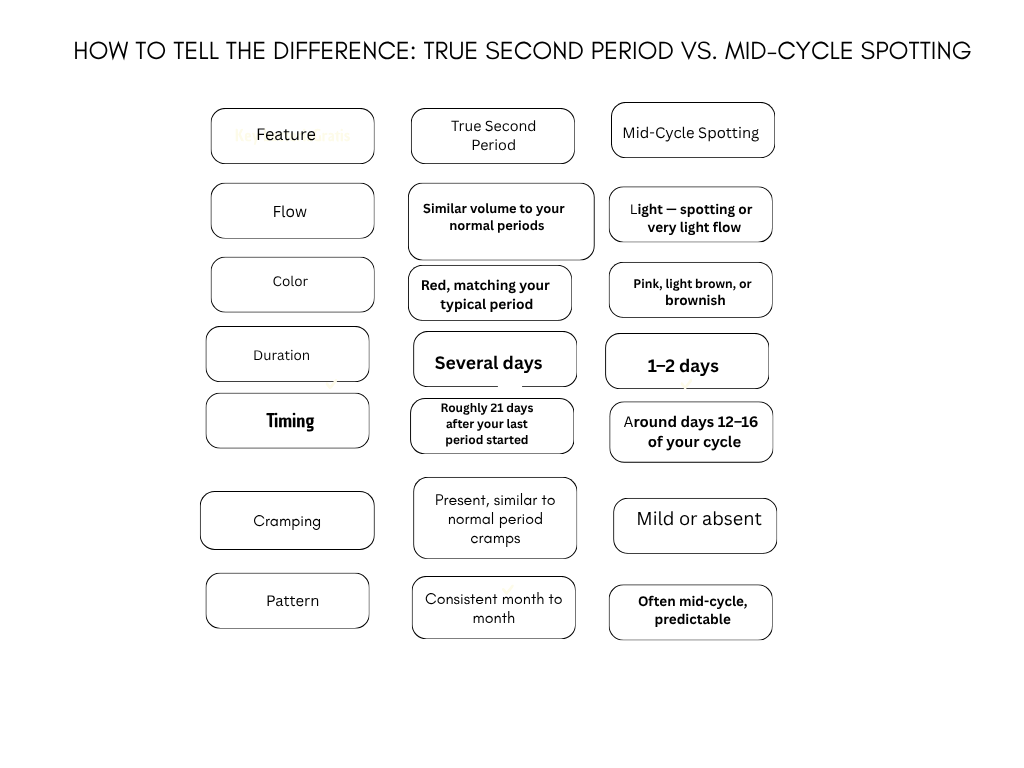
This distinction matters because it helps determine which type of evaluation is most useful gynecological, hormonal, or both.
When to See a Provider
You should contact your healthcare provider if:
Two periods in a month is a new pattern that was not previously your normal
The second bleed is heavy, painful, or accompanied by clotting
You have any bleeding after sex alongside the irregular pattern
Irregular periods are accompanied by other symptoms fatigue, weight changes, hair loss, hot flashes, or pelvic pain
You are over 45 and your cycle has recently become shorter or more frequent
Your periods have become increasingly irregular over several months
You have not had a cervical screening (Pap smear) in over three years and you have new bleeding irregularity this is worth scheduling alongside any gynecological workup
What to Expect at Your Appointment
Your provider will likely take a detailed menstrual and symptom history, perform a pelvic exam, and order:
Bloodwork — a complete blood count (CBC) to screen for anemia, plus hormonal panel including TSH, estrogen, progesterone, FSH, and LH
Pelvic ultrasound — to evaluate for fibroids, polyps, or structural uterine changes
Cervical screening — if not current, to rule out cervical causes
Pregnancy test — to rule out implantation bleeding or early pregnancy complications
Together these give your provider a complete picture quickly. Most causes of two periods in a month are identifiable and treatable the key is not dismissing the pattern as something to simply live with.
“This article is based on current medical guidance and research from the following trusted sources:”
Resources & Sources
Mayo Clinic — Menstrual Cycle: What's Normal, What's Not: mayoclinic.org
Cleveland Clinic — Abnormal Uterine Bleeding: clevelandclinic.org
Healthline — Two Periods in One Month: Should I Be Worried?: healthline.com
American College of Obstetricians and Gynecologists (ACOG) — Abnormal Uterine Bleeding: acog.org
Flo Health — Getting Your Period Twice a Month: flo.health
Medical News Today — Why Might Someone Get Two Periods in One Month?: medicalnewstoday.com
National Institutes of Health / PubMed — Menstrual Cycle Variability and Health: pubmed.ncbi.nlm.nih.gov
Centers for Disease Control (CDC) — About Irregular Periods: cdc.gov
Office on Women's Health — Your Menstrual Cycle: womenshealth.gov
Have you ever gotten your period twice in one month and just pushed through it, assuming it was normal? You are not the only one. Drop your experience in the comments.
Author
Becky Freeman is the founder of BVTalks® and Bee Vee Clean. She focuses on women’s intimate health, vaginal microbiome education, and creating practical, easy-to-understand content for everyday care.
Disclaimer: This post is for educational purposes only and is not a substitute for professional medical advice. Always consult your healthcare provider for diagnosis and treatment.
